961 ASCII to Morse Code Converter
961 : ASCII to Morse Code Converter
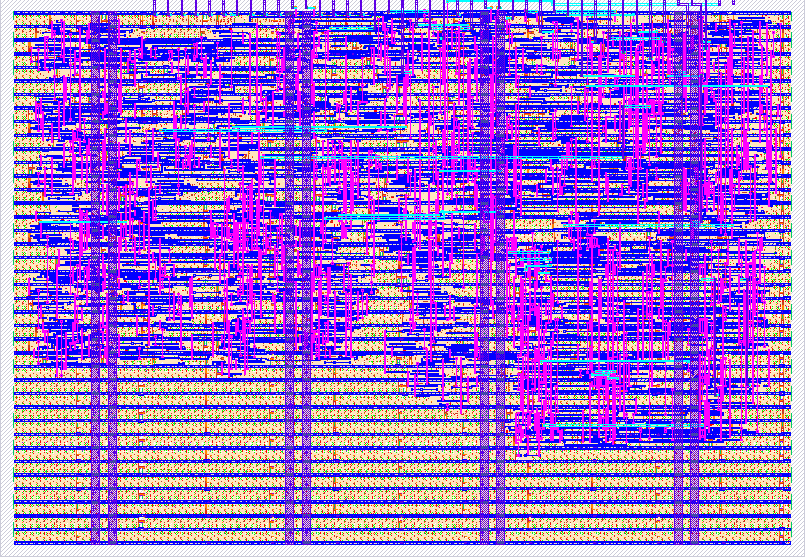
- Author: Vladimir Velikanov
- Description: Streams ASCII characters as ITU Morse code: key line, PWM sidetone for the Audio Pmod, and status on the 7-segment display
- GitHub repository
- Open in 3D viewer
- Open in Tiny Tapeout Explorer
- Clock: 10000000 Hz
How it works
A hardware ASCII-to-Morse converter. The host places a 7-bit ASCII code on
ui[6:0] and strobes load (ui[7]); the chip looks the character up in an
on-chip ROM and serializes the ITU-R M.1677-1 element sequence on the key
line (uo[0]) at a selectable, human-perceptible speed. The chip owns all
Morse timing; the host only feeds bytes and respects the ready flag, so a
simple polling loop in MicroPython can stream arbitrary-length text without
dropping characters.
The Morse stream is presented three ways simultaneously:
- Key line (
uo[0]): raw on/off keying for a scope, LED, or relay. - Audio (
uo[7]): the key line gated with a square-wave sidetone, encoded as 5-bit PWM at f_clk/32 (~312 kHz at 10 MHz) for the TT Audio Pmod. Silence is 50% duty, so the Pmod's filter output rests at mid-rail; keying is aligned to tone zero crossings to suppress clicks. - Visual:
uo[7:0]is also the demoboard's 7-segment bus, so the status bits light segments in sync with the transmitted code (segment a flashes withkey). Settingdisplay_en= 0 blanks the fast-toggling diagnostic segments (element,tick);key, the handshake lines and the audio are unaffected so the host protocol keeps working.
Character set: letters A-Z (lowercase folded to uppercase), digits
0-9, and the punctuation . , ? ' ! / ( ) & : ; = + - _ " @. An ASCII
space emits a word gap. Anything else asserts invalid, produces no key-down,
and is discarded; ready returns after one dit-time and invalid clears on
the next successful load. ($ is excluded: its seven-element pattern does not
fit the 6-bit ROM field.)
Timing (all durations are multiples of the dit-time T; PARIS is
exactly 50 T):
| Interval | Duration | Key state |
|---|---|---|
| Dit | 1 T | down |
| Dah | 3 T | down |
| Intra-character gap | 1 T | up |
| Inter-character gap | 3 T | up |
| Word gap (space) | 7 T | up |
Gaps are non-overlapping: the inter-character gap replaces the final intra-character gap, and a word gap replaces the inter-character gap (a space between letters gives exactly 7 T, not 10 T).
Speed selection (wpm_sel, dit-time = 2^N clocks; values at 10 MHz):
wpm_sel |
Divider | Dit-time | Approx. WPM |
|---|---|---|---|
000 |
2^21 | ~210 ms | ~5.7 (default) |
001 |
2^20 | ~105 ms | ~11.4 |
010 |
2^19 | ~52 ms | ~23 |
011 |
2^18 | ~26 ms | ~46 |
100 |
2^16 | ~6.6 ms | ~183 |
101 |
2^12 | ~0.41 ms | scope work |
110 |
2^8 | ~26 µs | hardware test |
111 |
2^4 | 1.6 µs | simulation turbo |
Timing is strictly clock-proportional. Speed and configuration changes take effect only at character boundaries, so a mid-character change cannot produce a malformed element.
Handshake: on a rising edge of load with ready high the character is
captured and ready falls. ready rises again during the trailing 3 T
inter-character gap, giving the host a full 3 T window to supply the next
character, so a continuous stream has no inserted pauses. A load edge while
ready is low is ignored. char_done pulses for one dit-time when a
character (including its gap) completes. load is two-flop synchronized;
pulses shorter than two clock periods are not guaranteed to register.
With auto_repeat = 1 the last character is re-sent indefinitely with
correct 3 T gaps until load is strobed again or the design is reset.
How to test
The design is meant to be driven from the demoboard's RP2350 running
MicroPython with the ttboard SDK (mode = ASIC_RP_CONTROL, since the RP2
drives the project inputs and the configuration byte on uio). A suitable
config.ini section:
[tt_um_morse_converter]
mode = ASIC_RP_CONTROL
clock_frequency = 10e6
uio_oe_pico = 0b11111111   ; RP2 drives all config pins
uio_in = 0b00001000        ; wpm_sel=000 (slowest), audio_en=1, tone=600Hz
ui_in = 0
Copy test/morse_demo.py to the demoboard and run the canonical bring-up
check:
import morse_demo
morse_demo.demo()   # sends "HELLO WORLD" at ~5.7 WPM
or drive it by hand:
from ttboard.demoboard import DemoBoard
from morse_demo import MorseSender

tt = DemoBoard.get()
tt.shuttle.tt_um_morse_converter.enable()
tt.clock_project_PWM(10e6)
tt.uio_oe_pico.value = 0xFF

sender = MorseSender(tt)
sender.configure(wpm_sel=0, audio=True, tone=0)
sender.send("CQ CQ CQ DE TT")
Confirm the code is audible on the Audio Pmod and visible as pulses on
uo[0] (segment a of the 7-segment display). Verify by ear against a Morse
reference, or capture uo[0] on a scope and measure the dit-time against the
speed table above.
The cocotb testbench (test/test.py) covers the reset state, every element
class, gap and PARIS timing, case folding, the handshake back-pressure rules,
streaming, speed scaling, audio gating, reset during transmission, and
auto-repeat. It interacts with the design only through the pins, so it is
portable to microcotb for hardware-in-the-loop runs.
External hardware
- TT Audio Pmod on the output
Pmod header; it takes the PWM sidetone on
uo[7]and drives a piezo or headphone jack. - Fallback without the Pmod: an LED (demoboard 7-segment already works) on
uo[0], or a piezo buzzer onuo[0]through a series resistor: a click-per-element rather than a tone, but the rhythm is fully audible.
Pinout
| Pin | Dir | Name | Description |
|---|---|---|---|
ui[6:0] |
in | char_in |
7-bit ASCII code, sampled on the rising edge of load |
ui[7] |
in | load |
Load strobe, edge-detected, accepted when ready is high |
uo[0] |
out | key |
Morse key line: high = mark |
uo[1] |
out | ready |
High when a new character may be loaded |
uo[2] |
out | busy |
High while serializing, including the trailing gap |
uo[3] |
out | element |
High during a dah, low during a dit (valid while key is high) |
uo[4] |
out | char_done |
One dit-time pulse at the end of each character |
uo[5] |
out | invalid |
Latched for characters with no Morse encoding |
uo[6] |
out | tick |
One-clock pulse at each dit boundary |
uo[7] |
out | audio_pwm |
PWM sidetone for the TT Audio Pmod |
uio[2:0] |
in | wpm_sel |
Speed select (see table) |
uio[3] |
in | audio_en |
1 = sidetone enabled |
uio[5:4] |
in | tone_sel |
Sidetone pitch: 600 / 800 / 1000 / 440 Hz |
uio[6] |
in | display_en |
0 = blank the element and tick segments |
uio[7] |
in | auto_repeat |
1 = re-send the last character indefinitely |
The design never drives the bidirectional pins (uio_oe = 0).
IO
| # | Input | Output | Bidirectional |
|---|---|---|---|
| 0 | char_in[0] | key | wpm_sel[0] |
| 1 | char_in[1] | ready | wpm_sel[1] |
| 2 | char_in[2] | busy | wpm_sel[2] |
| 3 | char_in[3] | element | audio_en |
| 4 | char_in[4] | char_done | tone_sel[0] |
| 5 | char_in[5] | invalid | tone_sel[1] |
| 6 | char_in[6] | tick | display_en |
| 7 | load | audio_pwm | auto_repeat |