172 LUT Spiking Network Classifier
172 : LUT Spiking Network Classifier
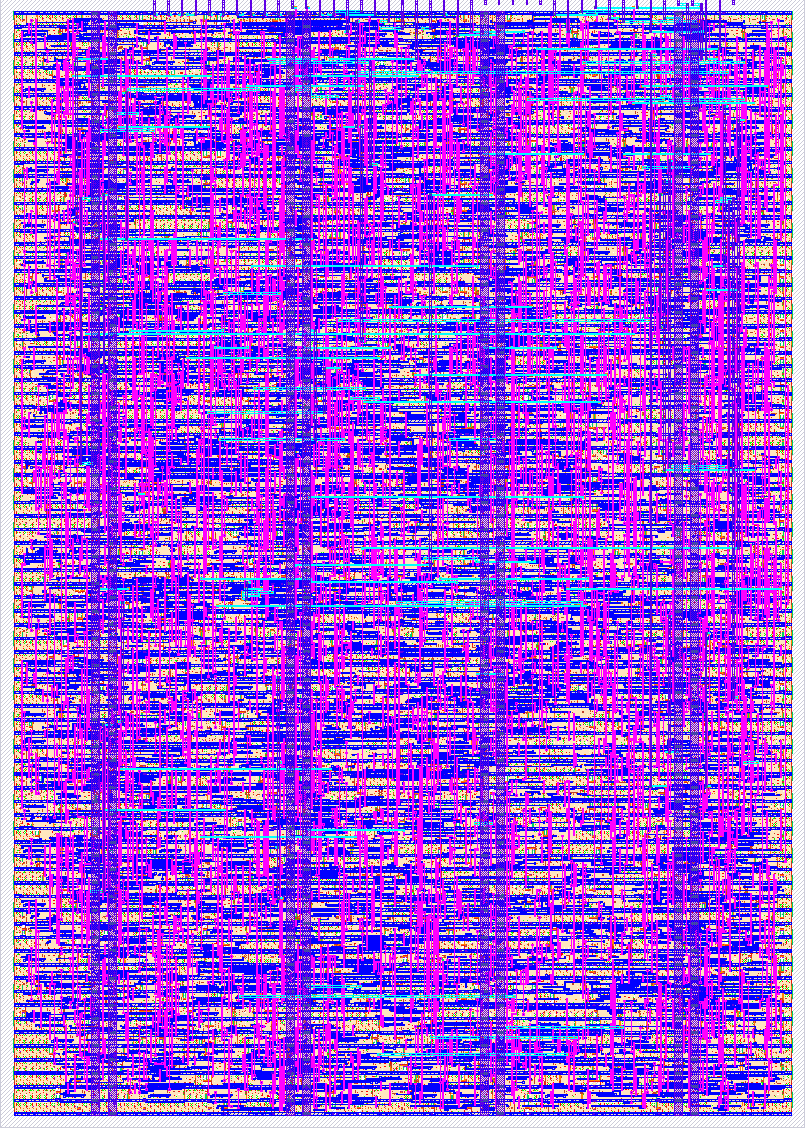
- Author: Niklas Anderson
- Description: Reconfigurable look-up-table spiking network (Izhikevich, 2025) classifying line orientation in a 3x3 grid
- GitHub repository
- Open in 3D viewer
- Open in Tiny Tapeout Explorer
- Clock: 50000000 Hz
How it works
A look-up-table (LUT) spiking network that classifies the orientation of a line in a 3x3 binary grid: class 0 = vertical, class 1 = horizontal. The weights are held in a register the client can rewrite at runtime, so this 1x2 tile design can run any retrained network of this shape rather than only the one compiled into it.
"Spiking" here means latency ordering, following Izhikevich's Spiking Manifesto (arXiv:2512.11843). There is no membrane potential, no threshold, no leak, and no time stepping — a neuron's state is simply when it fires, and only the relative order of firing times is ever consulted. Inference is compare, look up, add, compare.
Each of 4 tables watches 2 fixed pairs of input neurons. Each pair contributes one bit,
x[a] > x[b], and the two bits index one of the table's 4 rows. The layer output is the
element-wise sum of the 4 selected rows, and the earliest output spike wins:
bit r of table i = (x[a[i][r]] > x[b[i][r]])
y[k]             = sum over i of tables[i][j_i][k]
class            = argmin over k of y[k]
There is no multiplier anywhere and no activation function. All the nonlinearity is in which rows get selected. Because a lit cell must fire before a dark one and nothing but the ordering matters, the firing times can be just -1 and +1, which collapses each comparison to "cell a dark AND cell b lit" — one gate per index bit, with no subtractor or comparator on the input side.
Stored weights are plain signed 8-bit integers. 8 bits is the smallest width at which rounding provably cannot flip a decision for the default weights (worst-case shift 0.042 against a smallest decision margin of 0.077).
Total state: 320 bits of weights (16 four-bit anchor indices + 32 signed bytes) plus 12 flops of pipeline. Latency is a fixed 2 cycles, with no handshake; back-to-back inputs stream without gaps.
Grid bit order
Cell i is grid[8-i], so bit 8 is the top-left cell and bit 0 the bottom-right, read
row-major:
grid[8] grid[7] grid[6]
grid[5] grid[4] grid[3]
grid[2] grid[1] grid[0]
grid[7:0] arrives on ui[7:0] and grid[8] on uio[0].
Configuration
Weights live in a 320-bit shift chain. Hold CFG_WE high and present one byte per clock on
ui[7:0] for 40 clocks, keeping IN_VALID low for the whole load. The byte displaced off
the top of the chain appears on uo[7:0] in the same cycle, so a single pass both loads the new
weights and reads back the old ones. Writing those captured bytes back restores the previous
contents.
IN_VALID matters because the input path is not gated on CFG_WE: the network keeps sampling
it during a load, so asserting it mid-shift classifies a grid against half-written weights. The
answer is wrong and you cannot see it anyway, since uo[7:0] is carrying config bytes at the
time. Holding IN_VALID low avoids it entirely.
Byte order:
| bytes | contents |
|---|---|
| 0–3 | lut_anchor_a.mem lines 0–7: two 4-bit cell indices per byte, earlier line in the high nibble |
| 4–7 | lut_anchor_b.mem lines 0–7, same packing |
| 8–39 | lut_tables.mem lines 0–31: one signed byte each, entry (i*4 + j)*2 + k for table i, row j, output k |
New weights take effect on the next grid presented; nothing needs flushing.
Reset preloads a trained network, so the tile classifies correctly straight out of reset and configuration is entirely optional. The default is a reference 4x2 network:
anchor_a  4 6 0 8 4 3 4 0
anchor_b  1 2 2 2 8 6 3 7
tables    f9 03 ff 02 e1 0f 42 af 1b f0 94 75 71 9f 22 e4
          da 17 de 17 ed 10 7f 8e 19 e4 9f 5a f0 13 70 8c
as a 40-byte stream:
4608434012228637 f903ff02e10f42af1bf09475719f22e4da17de17ed107f8e19e49f5af013708c
How to test
Out of the box, no configuration. Present a grid on ui[7:0] + uio[0], pulse IN_VALID
(uio[1]) for one clock, and read CLASS on uo[0] two clocks later, qualified by
OUT_VALID on uo[1]. The six noise-free patterns:
| grid | bits | expected |
|---|---|---|
111000000 |
0x1C0 |
horizontal (1) |
000111000 |
0x038 |
horizontal (1) |
000000111 |
0x007 |
horizontal (1) |
100100100 |
0x124 |
vertical (0) |
010010010 |
0x092 |
vertical (0) |
001001001 |
0x049 |
vertical (0) |
Reconfiguration. Shift in 40 bytes with CFG_WE high, capturing uo[7:0] each cycle. The
captured bytes must equal the previous weights — for a freshly reset chip, the stream above.
Exchanging the two output columns of every table row (swapping bytes within each pair from
byte 8 onwards) inverts every decision, which is an easy end-to-end check that the config path
works.
Simulation. cd test && make runs the cocotb suite under Icarus. It enumerates rather
than samples: the input space is only 2^9 = 512 grids, so the equivalence tests drive every
one and compare against the checked-in golden vectors. That makes them a proof of
equivalence rather than a statistical argument. The suite covers the power-on default, a
reload of the same weights, and a genuinely different weight set.
Accuracy. 100% on the six clean patterns. Under independent per-cell flip noise at
p = 0.1, the exact expectation (all 512 grids weighted by probability, not sampled) is
80.99%. This is deliberately the small configuration; a 128-entry network of the same kind
reaches ~91% and a 38-parameter MLP reaches 93.4%, which is the Bayes ceiling for this noise
level.
A caveat on retraining. The anchor pairs are drawn at random at construction and frozen, so the 8-bit width is safe by construction for these weights, not universally — across 20 independently initialized networks the width needed ranges from 7 to 13 bits.
External hardware
None. Any microcontroller or FPGA that can drive 9 input bits and read 2 output bits is enough; loading weights needs one more output byte and one strobe.
IO
| # | Input | Output | Bidirectional |
|---|---|---|---|
| 0 | GRID0 / CFG_D0 - bottom-right cell | CLASS / CFG_Q0 - 0=vertical, 1=horizontal | GRID8 - top-left cell |
| 1 | GRID1 / CFG_D1 | OUT_VALID / CFG_Q1 | IN_VALID |
| 2 | GRID2 / CFG_D2 | CFG_Q2 | CFG_WE - hold for 40 clocks to load weights |
| 3 | GRID3 / CFG_D3 | CFG_Q3 | |
| 4 | GRID4 / CFG_D4 - center cell | CFG_Q4 | |
| 5 | GRID5 / CFG_D5 | CFG_Q5 | |
| 6 | GRID6 / CFG_D6 | CFG_Q6 | |
| 7 | GRID7 / CFG_D7 | CFG_Q7 |