779 ORCA — Online Reconfigurable Circuit with Adaptation
779 : ORCA — Online Reconfigurable Circuit with Adaptation
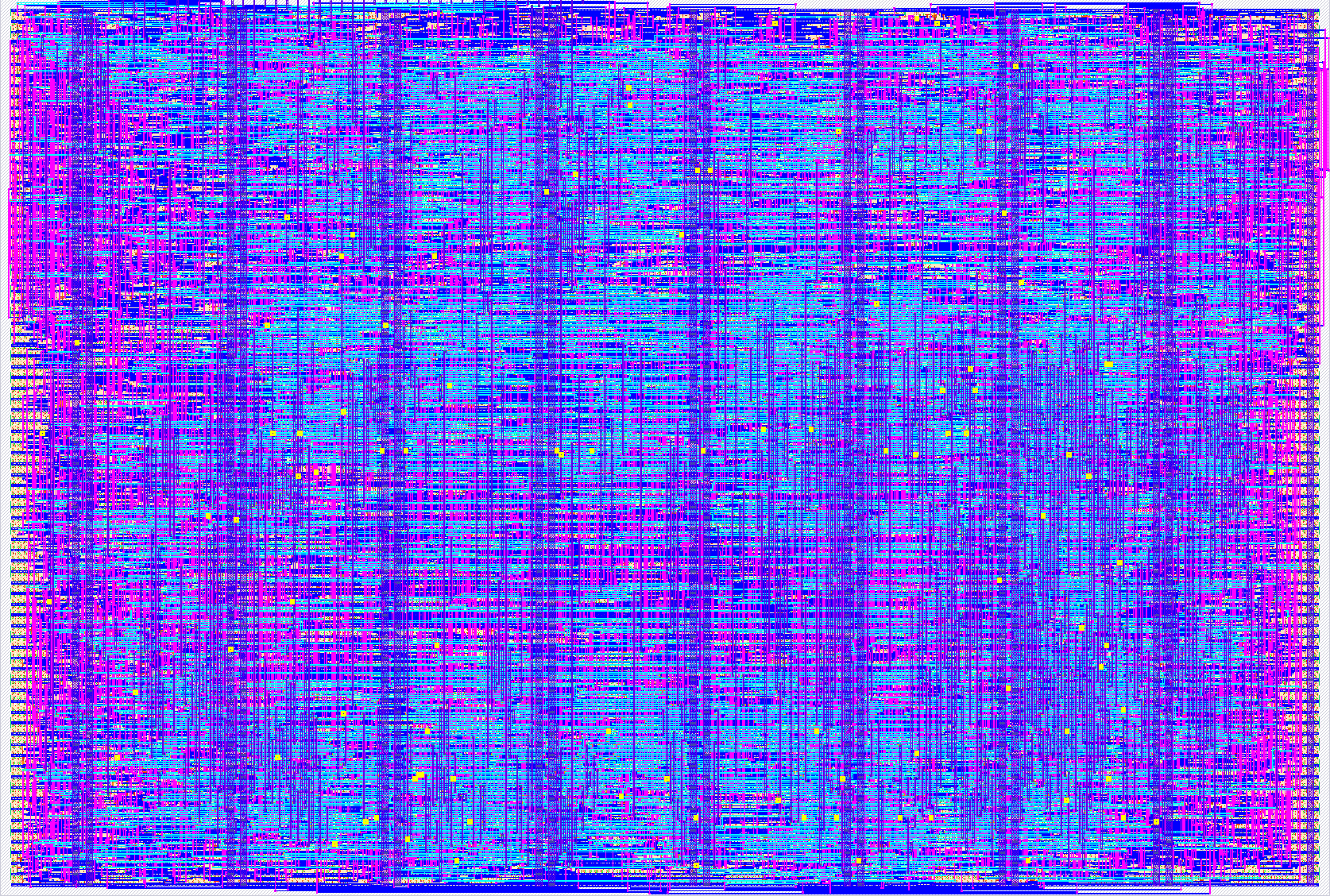
- Author: Abhi Alavilli
- Description: A self-optimizing, self-healing evolving logic engine
- GitHub repository
- Open in 3D viewer
- Open in Tiny Tapeout Explorer
- Clock: 25000000 Hz
How it works
ORCA is a self-optimizing, self-healing evolvable logic engine. It contains:
-
A CGP-style reconfigurable fabric — a 4×4 grid of cells, each an arbitrary 2-input Boolean function (4-bit LUT) with two 4:1 input muxes. Column 0 reads the 4 primary inputs; column c reads only column c−1 (strictly feed-forward, so combinational loops are impossible by construction). Two outputs are selected from the last column. The entire circuit is defined by a 132-bit genome.
-
An on-chip (1+1) evolution strategy. Each generation, a xorshift32 PRNG picks one genome bit to flip. An eval engine scores the resulting circuit against a 16-row × 2-output target truth table (fitness = correct outputs, with measured circuit speed as a lexicographic tiebreaker). Better-or-equal mutants are kept; worse ones are reverted via a single-entry mutation log (XOR is its own inverse). Optional simulated annealing accepts some worse mutants with decaying probability.
-
A settle-time sensor — a
dont_touchdelay-line that shrinks the fabric's compute window until it fails, measuring how fast the evolved circuit really is on this specific die. Evolution keeps optimizing speed after correctness is solved, exploiting this die's process variation (Thompson's classic experiment, on modern silicon).
At reset the target is parity + AND-OR, so the chip evolves with no host
attached: LEDs on uo_out[7:4] climb as fitness converges and uo_out[3]
lights when solved. A bit-banged serial interface (24-bit command frames on
ui_in[4:6], response on uio[3]) exposes every CSR: target truth table,
genome read/write, PRNG seed, fault injection, annealing temperature, fitness
counters, and the settle-tap measurement.
Demos: EVOLVE (converge on any loaded truth table), HEAL (inject stuck-at
faults and watch evolution route around the dead cells), CHARACTERIZE (read
per-die settle-tap profiles). HEAL needs no host: with ui[1] (anneal) held
high, a press on ui[2] kills 3 cells, re-baselines fitness, and arms the
annealing temperature — the solved LED drops, the fitness LEDs dip, and both
recover as evolution re-routes around the dead cells.
How to test
Smoke test with no host: strap ui_in[0] (run) high, clock at 25 MHz, and
watch uo_out[7:4] climb within a second; uo_out[3] = solved,
uo_out[0] = generation heartbeat, uo_out[1] = evolving.
Host-free HEAL demo: additionally strap ui_in[1] (anneal) high; once solved,
pulse ui_in[2] — solved drops and the fitness LEDs dip, then recover over a
few seconds as evolution routes around the three dead cells.
With the demo board host tools (host/ in the repo):
tt_orca.py --port /dev/ttyACM0 id            # reads 0x08CA ("ORCA")
tt_orca.py ... seed 0xDEADBEEF               # reseed the PRNG
tt_orca.py ... run                           # start evolution
tt_orca.py ... poll                          # generation / fitness / accepts
live_plot.py --port /dev/ttyACM0             # live fitness plot
tt_orca.py ... inject-fault 0x4420 0x0000    # HEAL demo (kills 3 cells)
The full cocotb suite (test/) runs against the behavioral RTL with
make -B and unit suites with make -B UNIT=fabric|fault|eval|es; the
evolution end-to-end test is bit-exact against the Python golden model in
model/.
External hardware
None required. Optional: scope on uio[4] (accept pulse trigger) and uio[5]
(delay-line tap strobe) for the CHARACTERIZE demo; LEDs/PMOD on uo_out.
Pinout
| Pin | Dir | Function |
|---|---|---|
| ui[0] | in | run (evolution enable) |
| ui[1] | in | anneal_en |
| ui[2] | in | fault_demo (rising edge kills 3 cells) |
| ui[3] | in | reserved |
| ui[4] | in | ser_data |
| ui[5] | in | ser_shift |
| ui[6] | in | ser_exec |
| ui[7] | in | reserved |
| uo[0] | out | heartbeat (generation counter bit) |
| uo[1] | out | evolving |
| uo[2] | out | accept pulse |
| uo[3] | out | solved |
| uo[7:4] | out | best_fitness[11:8] |
| uio[3] | out | ser_out (serial response) |
| uio[4] | out | scope trigger (= accept pulse) |
| uio[5] | out | settle-sensor tap strobe |
| uio[7] | out | fabric PO0 live |
IO
| # | Input | Output | Bidirectional |
|---|---|---|---|
| 0 | run_ena | heartbeat | unused |
| 1 | anneal_en | evolving | unused |
| 2 | fault_demo | accept_pulse | unused |
| 3 | reserved | solved | ser_out |
| 4 | ser_data | best_fitness_8 | scope_trigger |
| 5 | ser_shift | best_fitness_9 | settle_probe |
| 6 | ser_exec | best_fitness_10 | unused |
| 7 | reserved | best_fitness_11 | po_0 |