905 Poket Animal
905 : Poket Animal
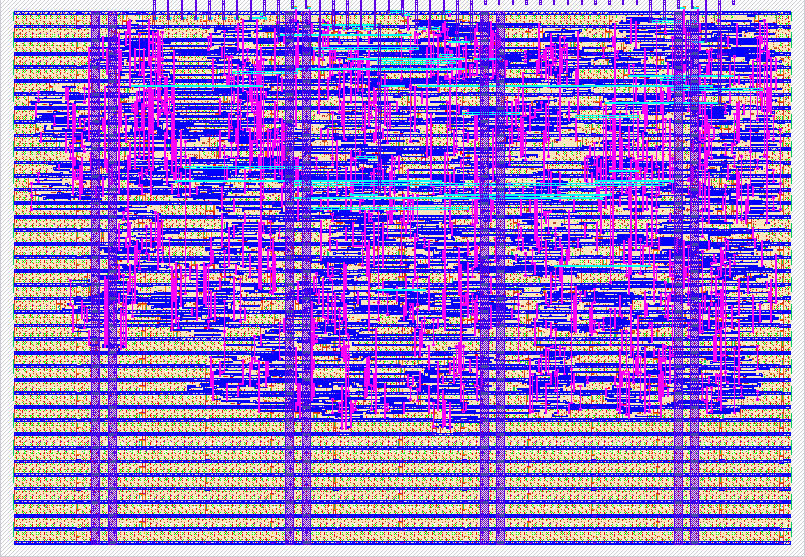
- Author: Vladimir Velikanov
- Description: A Silicon pet living in the 7-segment display. Features: hunger, joy, indigestion, mortality. Known errata: dies. Workaround: reset.
- GitHub repository
- Open in 3D viewer
- Open in Tiny Tapeout Explorer
- Clock: 10000000 Hz
How it works
A tiny tamagochi-style pet that lives in a 7-segment display.
The pet gets hungrier over time (full → peckish → hungry → starving, one level per metabolic tick) and shows its mood on the display:
| Mood | Display |
|---|---|
| content (hunger 0) | a single segment chasing around the ring (playing) |
| peckish (hunger 1) | - (meh) |
| hungry (hunger 2) | H blinking slowly |
| starving (hunger 3) | F blinking fast (FEED ME) |
| sick | b steady, decimal point blinking |
| dead | d steady + decimal point (a single tear) |
| being petted | everything flashing (pure joy) |
Pressing feed (ui[0]) removes one hunger level and the decimal point
lights up briefly (nom). Feeding a pet that is already full gives it
indigestion: three surplus snacks make it sick. A sick pet recovers after two
ticks of rest, but feeding it twice more kills it (cause of death: love).
Left starving for two ticks, it starves. Death is sticky — the tear is
permanent — and reincarnation is available via rst_n.
Pressing pet (ui[1]) makes it wiggle happily. A heartbeat on uio[1]
blinks faster as hunger grows and stops when dead. The remaining uio pins
report status: alive, cause of death, sick, hunger level, wiggle, and a
debug pulse per metabolic tick.
Metabolism and animation are decoupled and both derive from a free-running
prescaler, so the pet lives at pet speed while its face blinks at human speed.
ui[3:2] selects the time base (at the recommended 10 MHz clock):
ui[3:2] |
Tick | Use case |
|---|---|---|
00 |
~1.9 h | real pet: feed it at lunch, it survives the workday; ignore it overnight and it dies |
01 |
~27 s | needy pet (desk toy) |
10 |
~0.42 s | full lifecycle live demo |
11 |
64 clocks | simulation |
Metabolism is clock-proportional: halve the clock and it lives twice as long.
How to test
Connect a common-cathode 7-segment display to uo_out (the Tiny Tapeout demo
board already has one). Set the clock to 10 MHz and ui[3:2] to 10 (live
demo speed: one hunger tick every ~0.42 s), then reset.
The pet wakes up alive and slightly peckish (-). Watch it get hungry (H
blinking, then F flashing) and press ui[0] to feed it — the decimal point
noms. Keep it fed and it plays (a segment chases around the ring). Press
ui[1] to pet it and it wiggles. Overfeed it three snacks past full and it
gets sick (b); let it rest to recover, or keep feeding to learn about
consequences. Ignore it at maximum hunger and it dies (d with a tear).
Reset to reincarnate.
For simulation, the cocotb testbench in test/ runs the full lifecycle in
turbo mode (ui[3:2] = 11): birth, hunger, feeding, playing, petting,
starvation, reincarnation, overfeeding, recovery, death by love, and the
heartbeat.
External hardware
A 7-segment display with a decimal point on uo_out (segments a–g on
uo[6:0], decimal point on uo[7]), such as the one on the Tiny Tapeout
demo board. Two push buttons on ui[0] (feed) and ui[1] (pet), and two
switches or jumpers on ui[3:2] for speed select. Optionally an LED on
uio[1] for the heartbeat.
The buttons are debounced on-chip (the level must be stable for ~6.6 ms at 10 MHz), so bare switches work fine: contact bounce on press or release still counts as a single meal or pat.
IO
| # | Input | Output | Bidirectional |
|---|---|---|---|
| 0 | feed button (debounced ~6.6ms; one press = one meal) | segment a | alive |
| 1 | pet/affection button (debounced ~6.6ms; one press = one pat) | segment b | heartbeat (speeds up with hunger, stops when dead) |
| 2 | speed select bit 0 (00 real ~1.9h/tick, 01 needy ~27s, 10 demo ~0.4s, 11 sim) | segment c | cause of death (0: starved, 1: overfed) |
| 3 | speed select bit 1 | segment d | sick |
| 4 | segment e | hunger bit 0 | |
| 5 | segment f | hunger bit 1 | |
| 6 | segment g | wiggle (petting animation active) | |
| 7 | decimal point (nom indicator; queasy blink when sick; permanent tear when dead) | hunger tick (debug pulse) |