267 RRIO Op-amp
267 : RRIO Op-amp
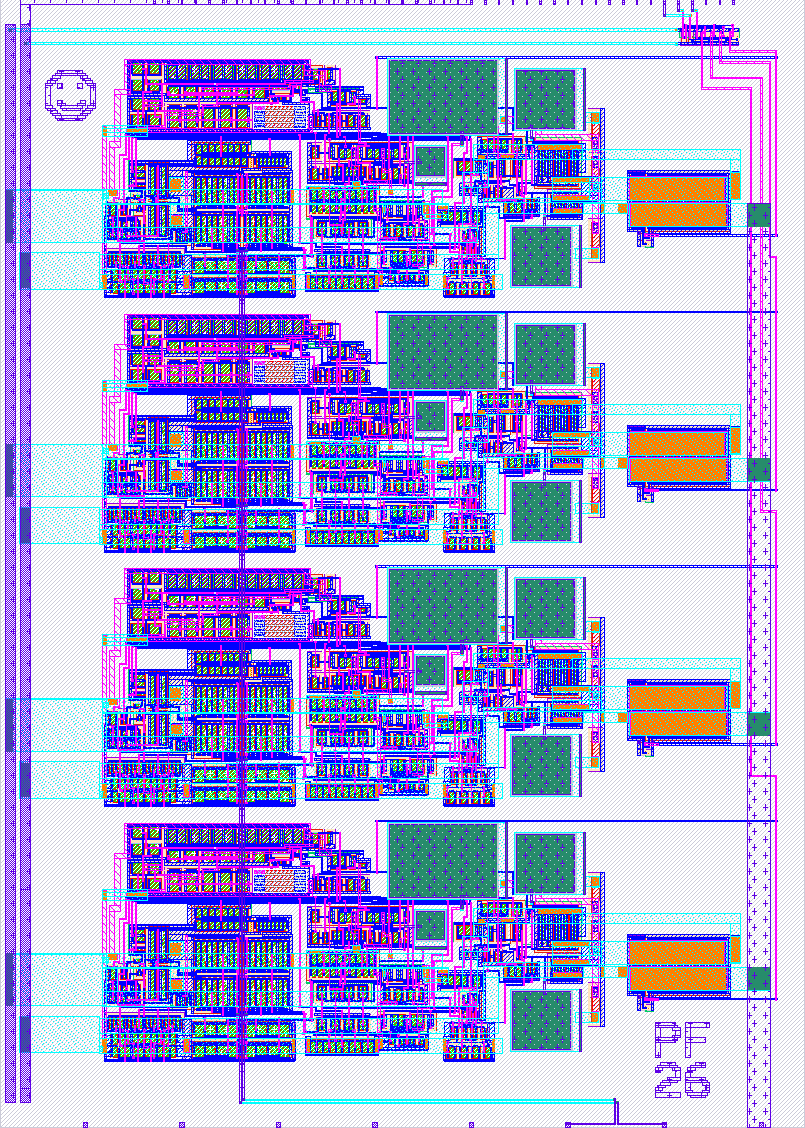
- Author: Park Frazer
- Description: 1.8V operational amplifier with rail-to-rail input and output
- GitHub repository
- Open in 3D viewer
- Open in Tiny Tapeout Explorer
- Clock: 0 Hz
How it works
This tile contains four instances of a 1.8V rail-to-rail opamp. The input pins are connected directly to all instances and the outputs are multiplexed to a single output pin.
How to test
Select an instance by setting the digital pins select[1:0] accordingly, then pull enable high.
The corresponding opamp should then function.
The compensation is not very good, so it might not be unity-gain stable in real life. It is optimized for ~10pF load capacitance.
What to test
Input offset voltage
I'm curious how the offset voltage compares to Monte Carlo simulations. The offset voltage will be different depending on which input pair is active so check at multiple common-mode voltages.
Stability
Check the overshoot/ringing in a step response when configured as a unity-gain follower. Try different load capacitances. Results will likely be poor. Measuring the open-loop frequency response would be interesting.
CMRR/PSRR
The CMRR from Monte Carlo simulations is not very good. With perfect matching it would be ~100dB.
IO
| # | Input | Output | Bidirectional |
|---|---|---|---|
| 0 | enable | -- | -- |
| 1 | instance[0] | -- | -- |
| 2 | instance[1] | -- | -- |
| 3 | -- | -- | -- |
| 4 | -- | -- | -- |
| 5 | -- | -- | -- |
| 6 | -- | -- | -- |
| 7 | -- | -- | -- |
Analog pins
ua | PCB Pin | Internal index | Description |
|---|---|---|---|
| 0 | Q | 11 | out |
| 1 | X | 6 | in- |
| 2 | R | 10 | in+ |