708 QKT MAC Accelerator
708 : QKT MAC Accelerator
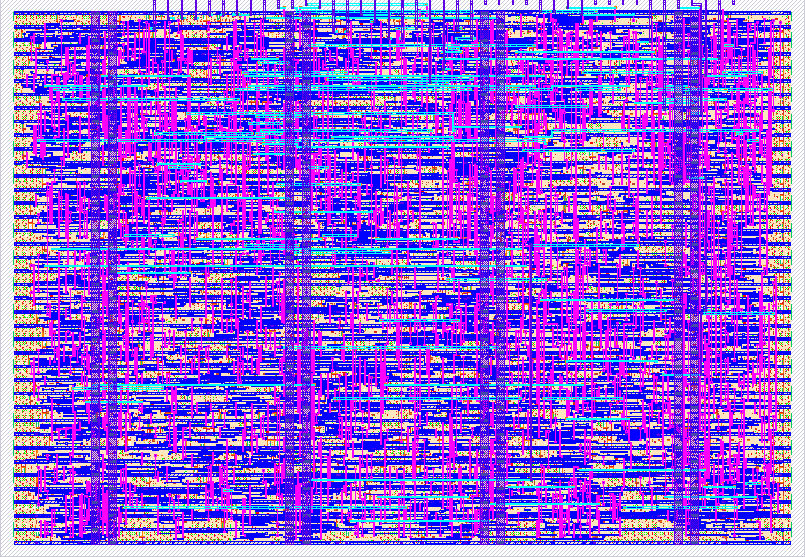
- Author: Pratibha Munnangi
- Description: INT8 signed 1x4 dot-product MAC with INT32 accumulator and streaming byte interface - a scaled-down demonstrator of a transformer QK^T attention kernel.
- GitHub repository
- Open in 3D viewer
- Open in Tiny Tapeout Explorer
- Clock: 100000000 Hz
How it works
This chip is a 1×4 INT4 signed dot-product MAC with an INT32 accumulator — the compute kernel at the heart of transformer self-attention (QKᵀ).
The datapath runs a 3-stage pipeline: four parallel INT4×INT4 signed multiplies, a 4-input adder tree, and an INT32 accumulate. A Q register holds the query nibble-vector and is reused across many streaming K vectors — the same Q-row reuse pattern used in real attention accelerators, just in miniature.
The chip has a stateless streaming byte interface: commands are decoded per cycle over 3 bits, and one nibble of data enters per cycle via the low half of ui_in. Four supported commands: LOAD_Q (shift a nibble into Q), LOAD_K (shift into K; the pipeline fires automatically on the 4th nibble), RESET_ACC (clear the accumulator without disturbing Q), and READ_ACC (stream the 32-bit accumulator out MSB-first over 4 cycles on uo_out).
Signed arithmetic throughout: INT4 operand range [-8, +7], INT8 product, INT10 partial sum, INT32 accumulator with saturating overflow-detect flag.
Design closes cleanly at 100 MHz on sky130 (setup slack +4.8 ns typical, +1.0 ns slow-slow) with 0 DRC / 0 LVS / 0 antenna violations, at ~77% single-tile utilization.
How to test
Drive the interface from a microcontroller or the demoboard's RP2040:
- Assert reset (
rst_nlow) for at least a few cycles, then release. - Load Q — send
cmd=1, valid_in=1four times, one nibble per cycle inui_in[3:0]. Q persists across many K vectors, so you only need to do this once per query row. - Load K — send
cmd=2, valid_in=1four times with one K nibble per cycle. After the 4th nibble, the pipeline fires; thedoneoutput (uio_out[7]) pulses ~4 cycles later. - Repeat step 3 for as many K vectors as you want; each result accumulates.
- Read the accumulator — send
cmd=3, valid_in=1once. The 32-bit signed result streams out onuo_outMSB-first over the next 4 cycles. - Clear the accumulator with
cmd=4between rows (Q is preserved).
Command encoding (on uio_in[2:0]): 1=LOAD_Q, 2=LOAD_K, 3=READ_ACC, 4=RESET_ACC. Assert valid_in on uio_in[3] when driving a command. Status flags on the upper uio_out bits: ready_out[4], busy[5], overflow[6], done[7].
Example: to compute q·k for q = [1, 2, 3, 4] and k = [7, 7, 7, 7], load nibbles 1,2,3,4 with LOAD_Q; then 7,7,7,7 with LOAD_K; wait for done; issue READ_ACC and read four bytes → 0x00000046 (= 70).
Full cocotb testbench with directed and randomized regression is in test/test.py.
External hardware
None. The chip is entirely self-contained and driven through the standard TT GPIO pads. Any host (RP2040, microcontroller, logic analyzer with pattern generator) that can drive the 3-bit command, valid strobe, and nibble input at up to 33 MHz can exercise it.
IO
| # | Input | Output | Bidirectional |
|---|---|---|---|
| 0 | data_in[0] | data_out[0] | cmd[0] |
| 1 | data_in[1] | data_out[1] | cmd[1] |
| 2 | data_in[2] | data_out[2] | cmd[2] |
| 3 | data_in[3] | data_out[3] | valid_in |
| 4 | data_in[4] | data_out[4] | ready_out |
| 5 | data_in[5] | data_out[5] | busy |
| 6 | data_in[6] | data_out[6] | overflow |
| 7 | data_in[7] | data_out[7] | done |