551 Single-Bit Macro Regime Classifier
551 : Single-Bit Macro Regime Classifier
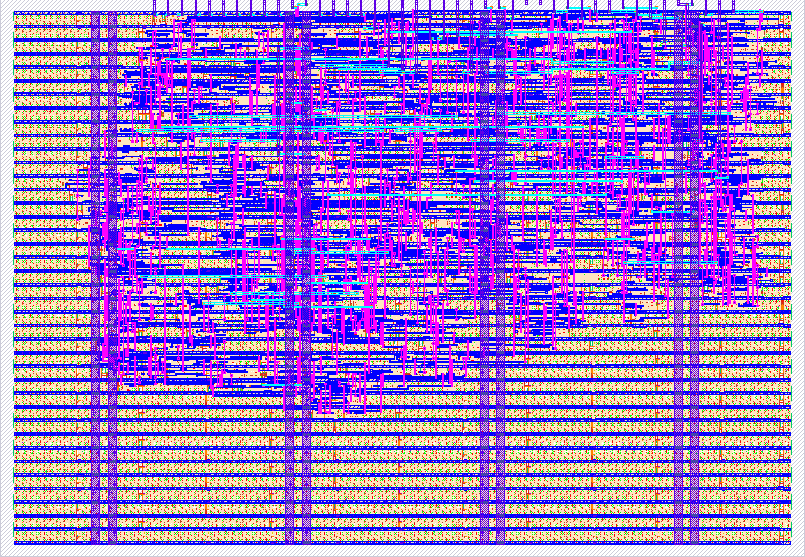
- Author: Shaun M. Rowles
- Description: 8-bit stream feeds a shift-only EMA compared against a programmable threshold with hysteresis; one output bit answers: in the regime, or not
- GitHub repository
- Open in 3D viewer
- Open in Tiny Tapeout Explorer
- Clock: 0 Hz
How it works
Each clock cycle, a new 8-bit sample arrives on the input pins — think of each number as today's reading of some economic gauge. The chip maintains a smoothed running average of the stream (an exponential moving average: old information fades, new information dominates) in a 16-bit accumulator:
acc <= acc + sample - (acc >> k)
where k (1-7, set on uio[2:0]) controls how fast old data fades. A right-shift by k is a divide by 2^k that costs almost no silicon, so the whole design uses no multipliers, no division, and no memory.
The average is compared against a programmable threshold with a hysteresis band, and the chip answers exactly one question on one wire, uo[7]: are we in the regime, or not? The regime bit turns on only when the average clears threshold + hysteresis, and off only when it falls below threshold - hysteresis, so the output never flickers when the data hovers near the line. The remaining outputs (uo[6:0]) expose the running average's top seven bits for observability.
Threshold and hysteresis are loaded from the input bus using two strobe pins: hold uio[7] high for one clock with the threshold value on ui[7:0], or uio[6] high with the hysteresis value.
A third rule adds persistence: the regime bit flips only after the average has qualified for N consecutive samples (N loaded via the uio[5] strobe; default 1 = flip immediately). One noisy print never changes the call — the same "sustained N periods" confirmation discipline used in regime frameworks, implemented as an 8-bit counter that resets whenever the streak breaks.
It is a macroeconomic regime call — the author's day job — reduced to its smallest honest expression and cast in physical silicon.
How to test
- Reset with
rst_nlow for a few cycles (defaults: threshold 128, hysteresis 8). - Set
uio[2:0]to a smoothing constant, e.g. 3. - Configure: pulse
uio[7]high for one clock with e.g. 100 onui[7:0](threshold), thenuio[6]high with e.g. 10 (hysteresis). Optionally pulseuio[5]with e.g. 8 to require eight consecutive qualifying samples before any flip. - Feed samples on
ui[7:0], one per clock. Feed values near 200 for a few hundred cycles:uo[7]goes high once the average climbs past threshold + hysteresis. Feed values near 5:uo[7]drops once the average falls below threshold − hysteresis. - Watch
uo[6:0]: the running average's top seven bits, at all times.
Nothing depends on clock speed — the design is correct at any frequency, per shared-die guidance. The cocotb testbench in test/ checks the RTL cycle-for-cycle against a bit-exact Python reference model (reference_model.py), including reset, convergence, both threshold directions, hysteresis no-flicker, saturation at both rails, and all eight smoothing constants.
External hardware
None. Any way to drive 8 input pins and observe 8 outputs (the Tiny Tapeout demo board is sufficient).
IO
| # | Input | Output | Bidirectional |
|---|---|---|---|
| 0 | DATA0 (sample bit 0, or config value during a load strobe) | EMA1 (running average bit 1) | K0 (smoothing shift, bit 0) |
| 1 | DATA1 | EMA2 | K1 |
| 2 | DATA2 | EMA3 | K2 (k=1..7; 0 treated as 1) |
| 3 | DATA3 | EMA4 | |
| 4 | DATA4 | EMA5 | |
| 5 | DATA5 | EMA6 | LOAD_PERSIST (strobe: latch ui as N-consecutive requirement) |
| 6 | DATA6 | EMA7 (running average MSB) | LOAD_HYST (strobe: latch ui as hysteresis) |
| 7 | DATA7 (MSB) | REGIME (1 = in regime) | LOAD_THRESH (strobe: latch ui as threshold) |