769 tt_sky26c
769 : tt_sky26c
- Author: Danny Rosen
- Description: Synaptic model, LIF Neuron
- GitHub repository
- Open in 3D viewer
- Open in Tiny Tapeout Explorer
- Clock: 20000000 Hz
How it works
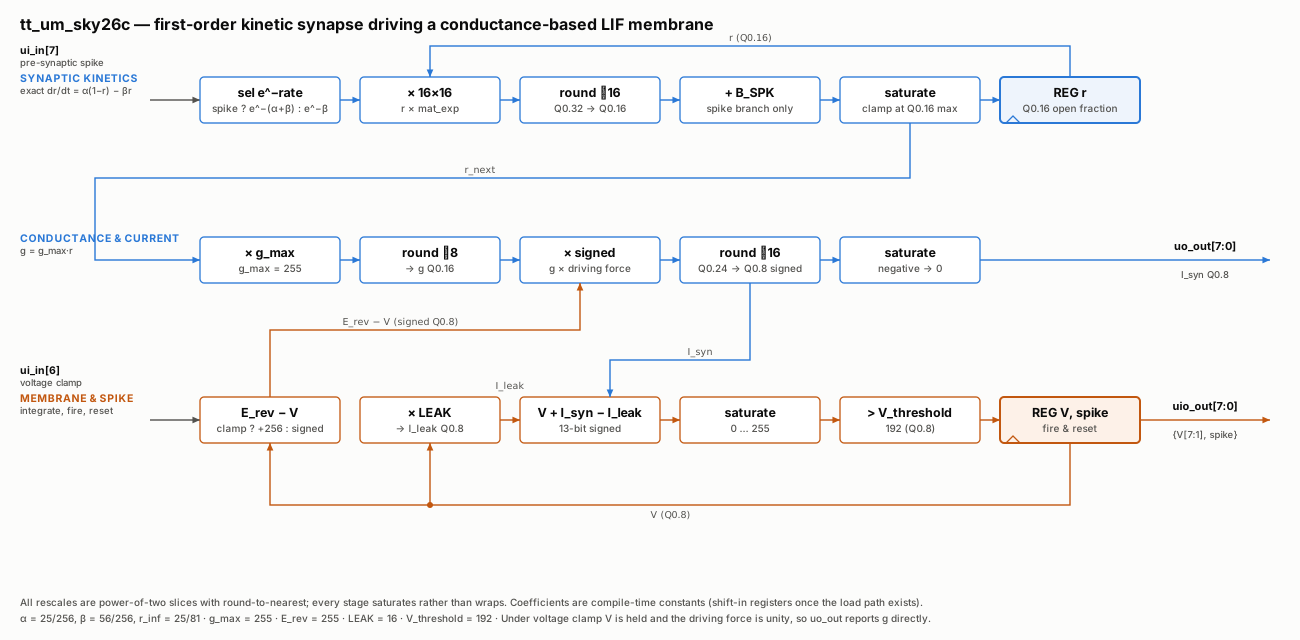
A discrete-time first-order kinetic (Markovian) synapse driving a leaky integrate-and-fire membrane.
Receptor state — r, the fraction of open post-synaptic receptors, follows
dr/dt = alpha*(1-r) - beta*r, integrated with the exact closed-form solution
(not forward Euler), so it is stable at any timestep:
- spike high:
r <- r*e^-(alpha+beta) + r_inf*(1 - e^-(alpha+beta)) - spike low:
r <- r*e^-beta alpha = 25/256,beta = 56/256,r_inf = alpha/(alpha+beta) = 25/81- coefficients stored as their exponentials in Q0.16, not as rates
- one 16x16 multiply covers both branches; only the offset differs
Membrane — g = g_max * r with g_max = 255/256, I_syn = g * (E_rev - V),
and V integrates I_syn less a linear leak:
I_synis signed, so it always pullsVtowardE_revE_revaboveV_threshold= excitatory; below = inhibitory, same pathV > V_thresholdfires: spike asserts one cycle,Vresets the following cycle — keeps the crossing observable, and gives a one-cycle refractory
Numerics
rand derivatives unsigned Q0.16;V,E_rev, leak unsigned Q0.8rneeds the extra width or a slow tau decays by < ½ LSB of Q0.8 and latches- every rescale is a power-of-two slice with round-to-nearest, never a divider
- every stage saturates instead of wrapping
Timing and reset
- one clock cycle = one model timestep; there is no multi-cycle update
- the coefficients are per-timestep, so Δt is whatever the clock says it is — the defaults above are the rates per cycle, not per second
- the cocotb suite clocks at 1 kHz, i.e. Δt = 1 ms of model time; silicon runs the same recurrence at 20 MHz
rst_nlow clearsr,V,spikeand the coefficient chain, so the part comes out of reset at rest on the default coefficientsui[5:2]anduio_inare unused;uio_oeis tied high, so the bidir bus is an output at all times
Coefficient load port
MAT_EXP_SPK, MAT_EXP_NSPK and B_SPK live in a 48-bit shift register.
ui[0]=cfg_din,ui[1]=cfg_shift- MSB first, 48 cycles:
MAT_EXP_SPK,MAT_EXP_NSPK,B_SPK - no room in the pin budget to stream 16 bits/cycle, hence serial + flops
cfg_shifthigh freezesr/V/spike, so a load costs no model time and a partial word never reaches a live update- reset clears the chain; an all-zero field selects that coefficient's default, independently of the other two
- zero is unusable anyway (zero
MAT_EXPcollapsesr, zeroB_SPKmakes the spike input inert), so it is free as the "never loaded" sentinel
Voltage clamp
ui[6]high holdsVand forces the driving force to unityuo_outthen reports the conductance waveform directly- a measurement mode for the kinetics, not a clamp at a command potential
Readout
uo_out=I_syn, Q0.8, unsigned — a negative current reads as 0uio_out={V[7:1], spike}; bit 0 is the post-synaptic spikeV[0]never leaves the chip, soVreads back only to even Q0.8 codes- add ½ step when reading to centre the error at ±0.5 LSB instead of biasing low
How to test
cd test
make -B
makeexits 0 even when assertions fail — grepresults.xmlforfailure- drive
ui[7]high for the cycles a pre-synaptic spike is present ui[6]selects clamped (conductance) vs. unclamped (full dynamics)- leave
ui[1:0]at 0 to run on the default coefficients - all inputs arrive on
ui_in, so the bidir bus is output at all times
Suite covers: impulse response, continuous drive to steady state, rest
condition, unclamped firing, and the load port both ways — shifting in the
defaults must reproduce the unconfigured trace sample for sample, and
perturbing each of the three fields must move the part of the waveform it
governs. Plots land in test/output/.
External hardware
None.
References
-
Destexhe, A., Mainen, Z. F., & Sejnowski, T. J. (1998). Kinetic models of synaptic transmission. In C. Koch & I. Segev (Eds.), Methods in Neuronal Modeling (2nd ed., pp. 1–25). MIT Press. — the first-order kinetic scheme this design implements.
-
Rotter, S., & Diesmann, M. (1999). Exact digital simulation of time-invariant linear systems with applications to neuronal modeling. Biological Cybernetics, 81(5–6), 381–402. — the exact discretization used instead of forward Euler.
IO
| # | Input | Output | Bidirectional |
|---|---|---|---|
| 0 | cfg_din | I_syn[0] | spike_out |
| 1 | cfg_shift | I_syn[1] | V[1] |
| 2 | I_syn[2] | V[2] | |
| 3 | I_syn[3] | V[3] | |
| 4 | I_syn[4] | V[4] | |
| 5 | I_syn[5] | V[5] | |
| 6 | voltage_clamp | I_syn[6] | V[6] |
| 7 | pre_spike | I_syn[7] | V[7] |